Why AI Might Not Take Our Jobs

The Devon View, written by Ben Jenkin, Portfolio Manager at Devon Funds.
Over the past year, the rapid ascent of generative AI has driven significant investor anxiety about the potential impacts the technology may have on businesses. As large language models demonstrate growing proficiency in research, coding, law, and creative writing, it is natural to anticipate widespread job disruption. In New Zealand, we have seen this anxiety manifest in local software company share prices, which have sold off significantly this year on AI-related fears, including Gentrack (-21%), Vista Group (-35%), and Serko (-46%). These large share price declines have occurred despite AI having no observable impact on their businesses, yet.
Devon’s portfolios have very limited exposure to these companies, but the broader conversation is relevant to nearly everything we invest in, and it’s something we’re thinking about very carefully. In our view, while AI will undoubtedly transform the nature of work, the degree of permanent workforce displacement remains less certain. We believe instead that we are witnessing a shift from AI as a tool to AI as a collaborator.
The difficulty in imagining this future, instead of the bleaker scenario, stems partly from the “End of History Illusion” - the tendency to believe that innovation has largely plateaued and that future needs will resemble today’s. It’s far easier to imagine an algorithm performing an existing job than to envision entirely new ones.
Consider the arrival of the electronic spreadsheet. The short-term fear mirrored today’s AI narrative: “We won’t need accountants anymore because software does the math instantly.”
The result was the opposite.
- Job volume: The number of accountants and auditors didn’t decline - it surged. In the United States, the profession grew from roughly 700k in 1980 to over 1.4 million today.
- Elasticity of demand: As the cost of performing calculations fell toward zero, demand for those calculations increased dramatically.
- Task migration: Companies stopped asking, “What are our numbers?” and started asking, “What could our numbers be?” Accountants evolved from human calculators into strategic advisors - roles requiring judgement, communication, and problem-solving.
We tend to see the destruction of tasks but miss the expansion of industries.
We are also living through what is often described as Amara’s Law: we overestimate the short-term impact of new technologies and underestimate their long-term effects. The internet provides a clear example. In the late 1990s, expectations for immediate monetisation of the internet led to the dot-com bubble. However, it took more than a decade for the infrastructure of the modern digital economy to mature.
AI appears to be in a similar phase today. Some fear it could replace lawyers, accountants, and doctors almost immediately. But the “last mile” of technology - reliability, accountability, and integration takes far longer than early demonstrations suggest.
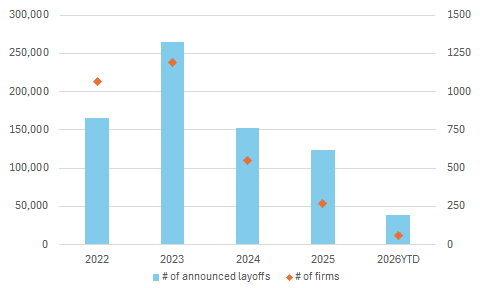
Recent analysis from JPMorgan highlights a counterintuitive trend: despite high-profile AI-related layoffs at companies like Meta and Amazon, total layoffs across the tech sector have declined since peaking in early 2023. AI is currently acting more as a catalyst for reorganisation than a driver of sustained job loss.
From Tools to Agents
A critical shift underway is the evolution from AI as a tool to AI as an agent:
- Tools require constant human input (like spreadsheets).
- Agents can execute multi-step tasks from a high-level goal.
Fears that agents will “take over” overlook a key constraint: the continued need for human oversight. In fields like finance, law, and medicine, the cost of error is simply too high. AI will not replace the lawyer, but the lawyer using AI may replace the one who does not. This is the emergence of a “centaur model” of work, where human judgment and machine capability combine to outperform either alone.
The Jevons Paradox and the Expansion of Work
The Jevons Paradox provides one of the most important lenses for understanding AI’s impact on labour markets. In 1865, economist William Stanley Jevons observed that as steam engines became more efficient, coal consumption didn’t fall - it increased. Lower costs made energy viable for entirely new uses.
The same dynamic is now unfolding with AI. As the cost of a “unit of intelligence” declines, whether that’s writing code, reviewing legal documents, or analysing data, demand doesn’t remain static. It expands.
Two effects are particularly important:
- The shadow task phenomenon: Every organisation has a backlog of valuable but uneconomical work - projects that aren’t worth a human analyst’s time at current costs. AI makes these tasks viable, unlocking entirely new layers of productivity.
- The complexity spiral: As systems become easier to build, they also become more complex. That complexity increases demand for high-level skills - architecture, security, integration, and strategy.
If work is viewed as a fixed pie, then automation reduces human opportunity. But history suggests the opposite: technology expands the pie. By lowering costs, it frees up capital and creativity to pursue new demands. Many modern roles - social media managers, data centre technicians, AI ethicists - would have been unimaginable just decades ago.
The idea that AI will eliminate the need for human work perhaps reflects a narrowness of imagination. Just as the steam engine liberated society from backbreaking physical labour and computers automated the tedium of manual calculation, AI will reduce cognitive drudgery.
Investment Implications
This dynamic has direct implications for capital allocation. The Jevons Paradox of AI implies a growing need for physical infrastructure - particularly data centres - to support expanding computational demand. The build-out of AI data centres is often compared to previous infrastructure booms: the 19th-century railways, the 20th-century electrical grid, and the 1990s fibre-optic expansion.
Unlike the fibre-optic build-out in the 1990s, which resulted in a significant amount of dark fibre (unused fibre-optic capacity), there is not a single “dark GPU” (chips used to power AI applications) in the world today. Additionally, regardless of how this technology ultimately transforms traditional workflows, we continue to see rapid adoption in the near term and a sustained need for the underlying infrastructure. We are monitoring this space closely and continuously refining our expectations around demand for computing capacity.
The debate around the long-term disruptive impact of AI will no doubt continue. What we know for sure is that the demand for AI computational power is growing rapidly. We view this as a secular opportunity, and our portfolios are positioned to benefit from this trend through investments in data centre developers such as Infratil and Goodman Group, which are projecting substantial growth in data centre revenues and are currently trading at attractive valuations relative to history.


_0.png)